
Peptide Shelf Life and Freezer Handling: Why Storage Matters
Proper freezer handling can help protect lyophilized peptides, preserve product integrity, and support long-term stability when storage conditions are controlled.
Peptide storage is one of the most important topics in product handling. Whether someone is reviewing research-use-only products, wellness-support options, or peptide-related documentation, storage conditions can have a major impact on product integrity over time.
At EGB Fitness & Body, we believe product education should include more than just what a peptide is. It should also include how peptides are handled, stored, protected, and understood responsibly.
One common question people ask is whether peptides can remain stable in the freezer for many years. The answer is: possibly, under the right conditions, depending on the peptide and the supporting product data.
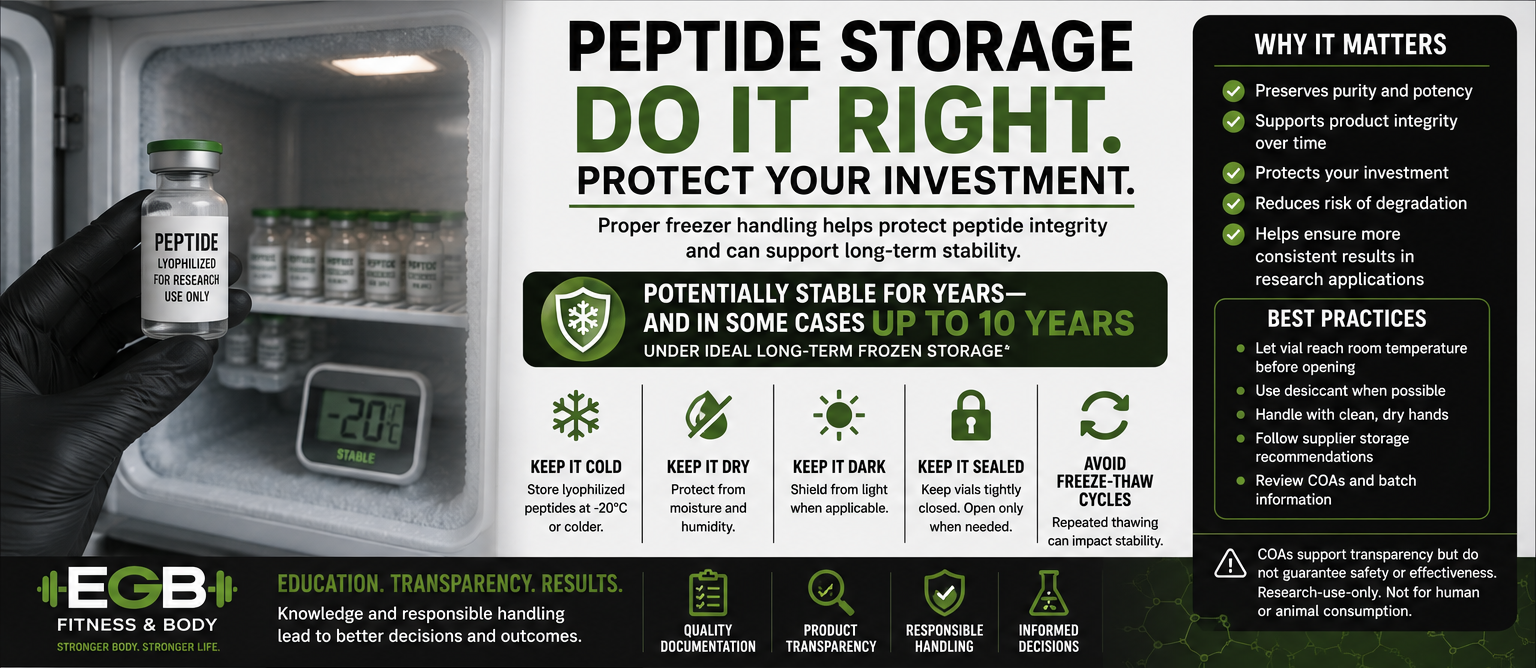
Proper freezer handling helps protect lyophilized peptide integrity and may support long-term stability when storage conditions are controlled.
Freezer storage can help protect peptide integrity, but stability depends on the peptide, the form, the packaging, and how consistently it is handled.
Lyophilized vs. Reconstituted Peptides
The first thing to understand is the difference between lyophilized peptides and reconstituted peptides.
Lyophilized peptides are dried into a powder-like form through a freeze-drying process. This dry state is generally more stable than a peptide that has already been mixed with liquid.
Reconstituted peptides have been mixed with a solvent or solution. Once liquid is introduced, the product may become more sensitive to time, temperature, contamination risk, and degradation.
Lyophilized peptides are generally more suitable for long-term storage than reconstituted peptides. Once a peptide is mixed with liquid, storage expectations usually become much shorter and more product-specific.
Why Freezer Storage Matters
Peptides can be sensitive to heat, moisture, oxygen, light, and repeated handling. Freezer storage helps slow many of the processes that can affect product stability over time.
For long-term storage, keeping lyophilized peptides cold, dry, sealed, and protected can help preserve integrity. The freezer helps reduce exposure to conditions that may contribute to breakdown or loss of quality.
Important freezer storage factors include:
- Consistent cold temperature
- Minimal temperature swings
- Protection from moisture
- Protection from light when applicable
- Sealed containers or vials
- Use of desiccant where appropriate
- Reduced freeze-thaw cycles
- Batch-specific product documentation
Can Peptides Be Stable for Up to 10 Years?
Some properly manufactured, unopened, lyophilized peptides may remain stable for years when stored under ideal frozen conditions. In certain cases, especially when kept deeply frozen, dry, sealed, and protected from repeated temperature changes, long-term stability may extend significantly.
However, “up to 10 years” should not be treated as a universal guarantee. Peptide stability depends on the specific peptide sequence, manufacturing quality, packaging, storage temperature, moisture exposure, oxygen exposure, and whether product-specific stability data is available.
The most responsible way to discuss long-term freezer storage is to say:
Properly stored lyophilized peptides may remain stable for extended periods, potentially for years and in some cases up to 10 years, when kept sealed, dry, protected, and continuously frozen. Actual stability depends on the specific peptide, storage conditions, and available product documentation.
This wording protects the educational value of the topic while avoiding a blanket claim that every peptide will remain stable for the same length of time.
Why Moisture Is a Major Concern
Moisture is one of the biggest concerns when handling lyophilized peptides. Many peptides can absorb moisture from the air, especially when a cold vial is opened too quickly after being removed from the freezer.
When a frozen vial is opened before it reaches room temperature, condensation can form. That moisture may affect the peptide powder and reduce overall stability.
A better handling approach is to allow the sealed vial to gradually reach room temperature before opening. This helps reduce condensation risk.
Keep It Dry
Moisture can reduce stability, especially when lyophilized powder is exposed repeatedly.
Let It Warm Sealed
Allowing the sealed vial to reach room temperature before opening helps reduce condensation.
Reseal Quickly
The less time a vial is exposed to air, the better the chance of preserving integrity.
Avoid Repeated Freeze-Thaw Cycles
Repeated freezing and thawing can create unnecessary stress on stored materials. For peptides, it is usually better to limit how often a vial is removed from the freezer, warmed, opened, and returned.
For research settings, aliquoting may help reduce repeated handling. This means dividing material into smaller portions so the main supply does not need to be exposed as often.
The goal is simple: reduce unnecessary exposure.
- Do not repeatedly open the same vial if avoidable
- Limit time outside the freezer
- Keep vials sealed when warming
- Avoid moisture exposure
- Use smaller portions when appropriate
- Follow supplier-specific handling guidance
Temperature Consistency Matters
Freezer storage works best when the temperature stays consistent. A peptide stored in a freezer that is frequently opened, unplugged, thawed, or exposed to repeated temperature swings may not have the same stability as one kept in a more controlled environment.
For long-term storage, temperature control is part of the quality conversation. This is especially important when discussing storage periods measured in years.
Better long-term storage practices may include:
- Using a reliable freezer
- Keeping vials sealed and organized
- Minimizing door-open time
- Storing away from light-sensitive exposure
- Tracking received dates and lot numbers
- Reviewing COAs and available product documentation
- Following supplier storage recommendations
Why Product-Specific Documentation Matters
Not all peptides behave the same way. Some sequences may be more sensitive than others. Certain amino acids and structures may make a peptide more vulnerable to oxidation, degradation, or shorter shelf life.
That is why product-specific documentation matters.
Helpful documentation may include:
- Certificate of Analysis
- Batch or lot number
- Storage instructions
- Testing date
- Purity or identity testing where applicable
- Supplier handling guidance
- Expiration or retest date where available
A COA can support transparency, but it does not guarantee unlimited stability. Storage claims should always be reviewed alongside the actual product documentation.
Long-term freezer storage is only as strong as the handling, packaging, temperature control, and documentation behind it.
Best Practices for Lyophilized Peptide Freezer Handling
For general educational purposes, lyophilized peptide handling should focus on protecting the product from the conditions that most commonly affect stability.
Helpful best practices include:
- Store unopened lyophilized peptides frozen when long-term storage is needed
- Keep vials sealed until ready for appropriate use
- Allow sealed vials to warm to room temperature before opening
- Avoid condensation inside the vial
- Minimize exposure to air and moisture
- Protect light-sensitive materials from light
- Use desiccant where appropriate
- Reseal containers tightly
- Limit repeated freeze-thaw cycles
- Track batch numbers, dates received, and available documentation
- Follow supplier or manufacturer storage guidance
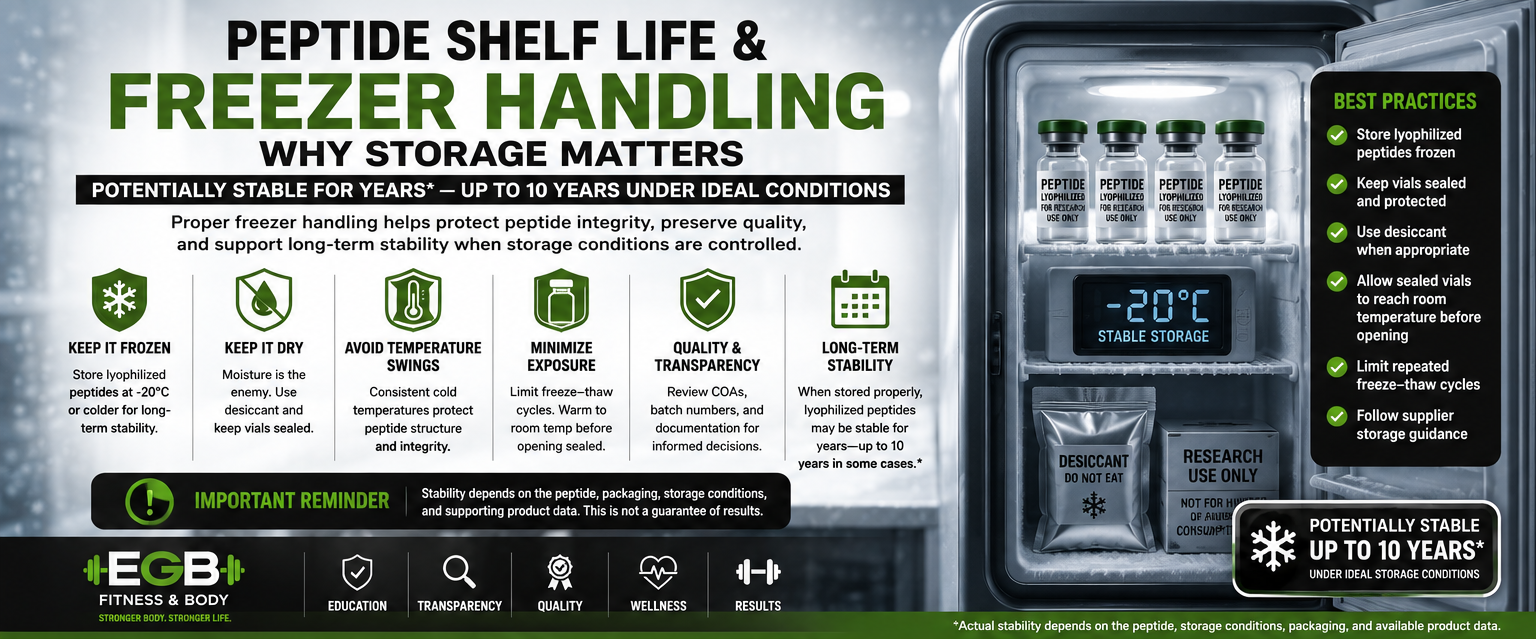
Long-term peptide storage depends on proper handling, consistent temperature, moisture control, and product-specific documentation.
What About Reconstituted Peptides?
Reconstituted peptides are different. Once a peptide has been mixed with liquid, long-term freezer storage expectations usually change. In most cases, after a peptide is rehydrated, it is commonly stored in a refrigerator. In other cases, some reconstituted peptides may be stored at room temperature depending on the specific peptide, solvent, formulation, and supplier guidance.
Reconstituted materials may be more sensitive to contamination, pH, solvent choice, temperature, and degradation over time. Because of this, reconstituted peptides should be handled according to supplier guidance, research protocols, or qualified professional direction where applicable.
The main point is this:
Long-term frozen storage claims generally apply more to unopened, dry, lyophilized peptides than to reconstituted peptide solutions. Once a peptide is reconstituted, storage expectations are usually shorter and more dependent on the specific product and handling conditions.
How EGB Fitness & Body Frames the Conversation
At EGB Fitness & Body, we believe peptide education should include transparency, responsible expectations, and product-handling awareness.
Storage matters because it connects directly to product integrity. If someone is asking about peptide-related products, they should also be asking how the product is stored, how it is handled, what documentation is available, and whether the storage expectations are product-specific.
We believe people should ask better questions, including:
- Is this product lyophilized or reconstituted?
- What does the supplier recommend for storage?
- Is the product labeled research use only?
- Is a COA available?
- Is there a batch or lot number?
- Is there a retest date or expiration date?
- Has the product been stored consistently frozen?
- Has the vial been protected from moisture and repeated thawing?
Final Thoughts
Peptide freezer handling matters. Properly stored lyophilized peptides may remain stable for extended periods, and under ideal conditions, some may potentially remain stable for years or even up to 10 years. But that should always be understood as product-specific, storage-dependent, and documentation-dependent.
The safest educational message is not that every peptide lasts 10 years. The better message is that long-term stability depends on protecting the product from heat, moisture, oxygen, light, and repeated handling.
Keep it sealed. Keep it dry. Keep it cold. Avoid unnecessary thawing. Review documentation. Ask questions. Respect the difference between lyophilized and reconstituted products.
At EGB Fitness & Body, we believe transparency and education help people make better wellness-support decisions.
Have Questions About Peptide Storage or Product Documentation?
Contact EGB Fitness & Body to ask about current product information, available documentation, wellness-support education, and responsible product-handling guidance.
Contact EGB Fitness & Body