
What Is a Peptide COA and Why Does It Matter?
A beginner-friendly guide to understanding Certificates of Analysis, product transparency, and why documentation matters in the peptide and wellness-support space.
As interest in peptides, wellness-support products, and research-use-only products continues to grow, one topic keeps coming up more often: COAs.
COA stands for Certificate of Analysis. It is a document that may provide testing information about a specific product, batch, or lot. For people exploring peptide-related products, a COA can be an important part of understanding product transparency and quality documentation.
At EGB Fitness & Body, we believe education should come before action. When it comes to wellness-support products, knowing what questions to ask can be just as important as knowing what products are available.
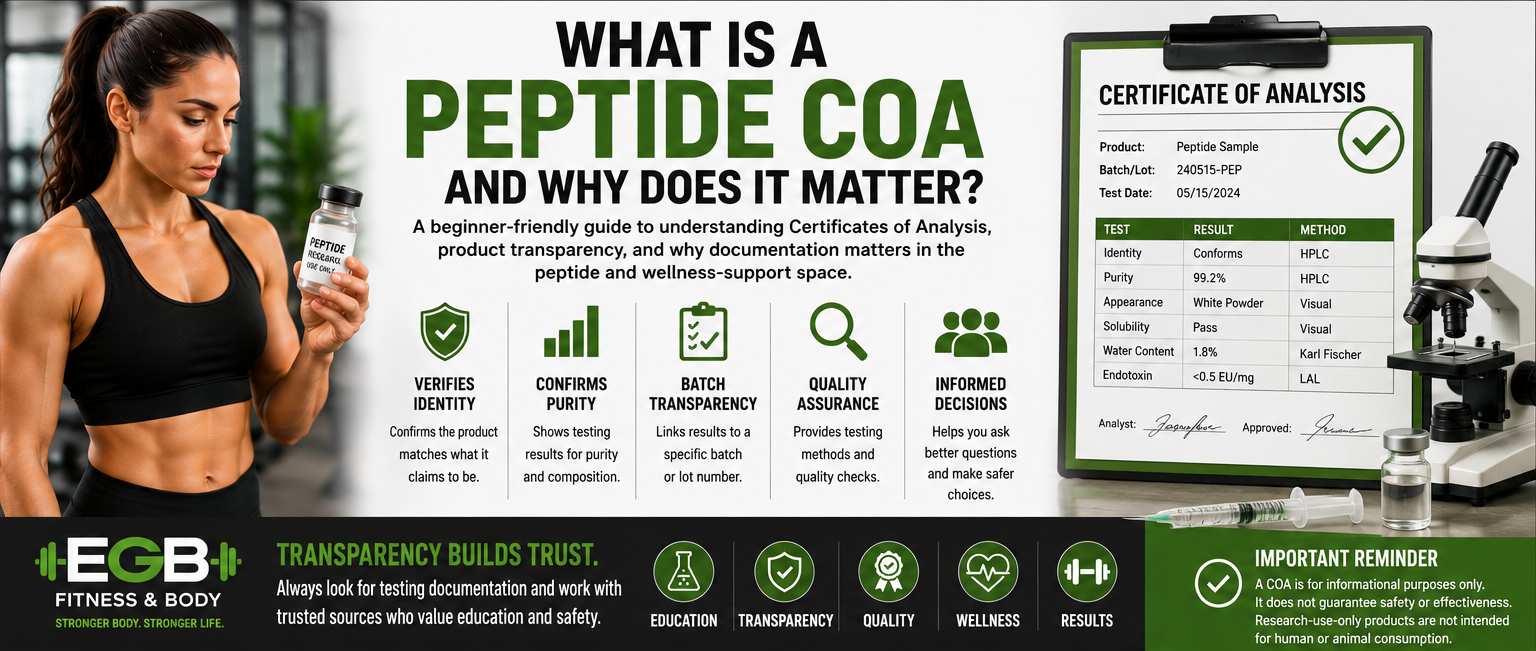
Understanding COAs helps you make informed choices and prioritize transparency, quality, and safety.
A COA is not just paperwork. It is part of the product transparency conversation.
What Is a COA?
A Certificate of Analysis is a testing document that may provide information about a product’s identity, purity, batch details, and other quality-related results, depending on the type of testing performed.
In simple terms, a COA helps answer the question:
A COA may help provide additional insight into whether a product matches the stated identity, batch, or quality information provided by the supplier.
Not every COA looks the same. Different labs, suppliers, product types, and testing methods may provide different levels of information. That is why it is important to review the document carefully and understand what it does and does not show.
Why COAs Matter in the Peptide Space
Peptides are often discussed in fitness, wellness, recovery, body composition, and research settings. Because interest in this category is growing, product transparency matters more than ever.
Not every product on the market is created with the same standards. Not every supplier provides the same level of documentation. A COA can help support a more informed conversation by giving people access to available testing information.
A COA may help provide information related to:
- Product identity
- Batch or lot number
- Purity percentage, where applicable
- Testing method used
- Testing date
- Lab or testing provider information
- Results for specific quality markers
This does not mean a COA answers every question. But it can be a useful part of evaluating product transparency.
What Information Might Be on a Peptide COA?
While each COA may look different, many peptide-related COAs may include several common sections.
Product Name
Identifies the product or compound being tested, based on the information submitted to the lab.
Batch or Lot Number
Helps connect the testing document to a specific production batch or lot.
Purity Information
May show a reported purity percentage or related testing result where applicable.
Testing Method
May identify the type of testing used, such as analytical methods commonly used for identity or purity review.
Testing Date
Shows when the sample was tested or when the report was issued.
Lab Information
May include the laboratory name, report details, or other identifying information.
COA Does Not Mean “Guaranteed”
It is important to understand what a COA is not.
A COA is not a medical recommendation. It is not a guarantee of results. It is not proof that a product is appropriate for a specific person or specific use. It also does not replace professional guidance.
A COA is a testing document. It should be viewed as one piece of the broader quality and transparency conversation.
A COA may provide useful product information, but it should not be treated as medical advice, usage guidance, or a guarantee of safety or effectiveness.
Why Batch Numbers Matter
One of the most important things to look for on a COA is whether the document connects to a specific batch or lot number.
Batch information matters because products may be produced, packaged, or tested in groups. A COA tied to a batch can help connect the testing information to the product being discussed.
Without batch or lot details, it may be harder to understand exactly what product the document refers to.
Why Testing Dates Matter
The date on a COA can also matter. Testing information should be reviewed in context. A recent report may provide more current documentation than an outdated one, depending on the product and supplier.
This does not mean older testing is automatically meaningless, but it does mean the timing of the test is worth paying attention to.
Why Source Transparency Matters
Product transparency is about more than having a document. It is also about how clearly a supplier communicates.
A responsible supplier should be willing to provide available product information, explain what documentation is available, and avoid exaggerated or unrealistic claims.
Questions worth asking include:
- Is product documentation available upon request?
- Does the COA match the product or batch being discussed?
- Is the information easy to understand?
- Are claims being made responsibly?
- Is the product clearly identified as research-use-only when applicable?
- Is professional guidance recommended where appropriate?
Research-Use-Only Products and COAs
Some peptide-related products may be labeled or discussed as research-use-only. In those cases, product documentation can be especially important for transparency.
Research-use-only products are generally not intended for human or animal consumption unless otherwise stated by the manufacturer and permitted by applicable law. That is why clear labeling, responsible communication, and available documentation matter.
A COA may help provide product-related information, but it does not change the intended use of a product.
Documentation supports transparency, but it does not change responsible-use expectations.
How COAs Fit Into a Responsible Wellness Conversation
At EGB Fitness & Body, we believe people deserve clear information. Whether someone is asking about training, wellness support, or current product information, the goal should be education and transparency.
A COA can help support that conversation by providing product-specific documentation where applicable.
But COAs should be viewed alongside other important factors, including:
- Clear product labeling
- Responsible communication
- Available testing details
- Professional guidance when appropriate
- Understanding product purpose and intended use
- A realistic view of results and expectations
What Should You Ask Before Reviewing a COA?
If you are reviewing a COA or asking for product documentation, here are some helpful questions:
- What product does this COA apply to?
- Does the product name match what I am asking about?
- Is there a batch or lot number?
- When was the test performed?
- What testing method was used?
- What does the report actually measure?
- Does the supplier explain the document clearly?
- Are there any claims being made that sound unrealistic?
Asking better questions helps create a more informed and responsible conversation.
The EGB Fitness & Body Approach
EGB Fitness & Body is focused on helping people improve their fitness, wellness, confidence, and education through practical support and responsible guidance.
When it comes to wellness-support products, peptides, or research-use-only products, we believe transparency matters. Product details and available testing documentation, including Certificates of Analysis, may be provided upon request where applicable.
Our goal is not to create hype. Our goal is to help people ask better questions, understand available information, and make more informed decisions.
Final Thoughts
A peptide COA can be an important part of the product transparency conversation. It may provide information about identity, purity, batch details, testing dates, and other quality-related information depending on the document and testing performed.
But a COA should be understood correctly. It is not a medical recommendation. It is not a guarantee of results. It is not a replacement for professional guidance.
The best approach is to stay informed, ask questions, review available documentation, and keep wellness decisions grounded in education and responsibility.
At EGB Fitness & Body, we believe that quality conversations start with transparency. Whether you are focused on training, wellness support, or current product information, we are here to help guide the conversation responsibly.
Have Questions About Product Documentation?
Contact EGB Fitness & Body to ask about current product information, available testing documentation, and wellness-support options available upon request.
This content is for general informational and educational purposes only. EGB Fitness & Body does not provide medical advice, diagnosis, or treatment. Certificates of Analysis and product documentation are provided for informational purposes only and should not be interpreted as medical guidance, usage instructions, or a guarantee of safety or effectiveness. Peptides, supplements, wellness products, and research-use-only products should be discussed with a qualified healthcare professional before use. Research-use-only products are not intended to diagnose, treat, cure, or prevent any disease and are not intended for human or animal consumption unless otherwise stated by the manufacturer and permitted by applicable law. Results vary by individual.