
Understanding Peptide Sources: Compounding Providers, RUO Products, and the Gray Market
A practical guide to understanding different peptide source categories, why transparency matters, and how accurate testing documentation can help people ask better questions.
Peptides have become one of the most talked-about topics in fitness, wellness, recovery, body composition, and longevity conversations. As interest grows, so does the importance of understanding where peptide-related products come from and how different source categories compare.
Not every peptide source is the same. A licensed compounding provider, a research-use-only supplier, and a gray market peptide provider may operate under very different expectations, rules, documentation practices, and intended-use limitations.
At EGB Fitness & Body, we believe the conversation should be built around education, transparency, documentation, and responsible decision-making. The goal is not to create fear or hype. The goal is to help people understand the differences so they can ask better questions.
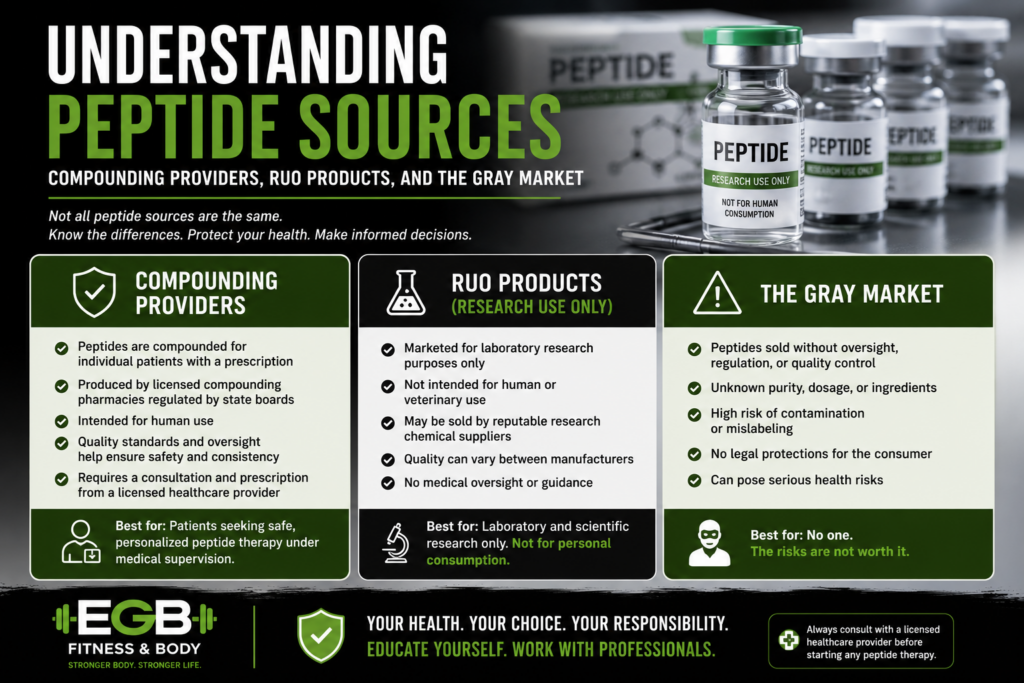
Understanding peptide sources helps support better questions around product transparency, documentation, intended use, and responsible decision-making.
In the peptide space, source transparency matters as much as product interest.
Why Peptide Source Matters
Peptides are often discussed as if they all come from the same type of place. That is not accurate. Different products may come through different channels, including medical providers, licensed compounding pharmacies, research-use-only suppliers, and nontraditional online sources commonly referred to as the gray market.
Understanding the source matters because source can affect how a product is labeled, what documentation is available, what claims are being made, and what level of oversight may exist.
Important questions include:
- Is this a prescription medication?
- Is it coming from a licensed pharmacy or compounding provider?
- Is it labeled for research use only?
- Is a Certificate of Analysis available?
- Does the COA match the product batch or lot?
- Are claims being made responsibly?
- Is the source transparent about testing and documentation?
These questions are not meant to scare people. They are meant to create a more informed conversation.
Category 1: FDA-Approved Medications
FDA-approved medications have gone through a formal review process for specific approved uses. That process evaluates safety, effectiveness, labeling, manufacturing quality, and other requirements before the product is approved for the market.
When someone is using an FDA-approved medication, it is typically prescribed by a licensed healthcare provider and dispensed through a licensed pharmacy.
This category is different from compounded medications, research-use-only products, and gray market sources.
FDA-approved medications and peptide-related products sold outside approved medical channels should not be treated as the same category.
Category 2: Compounding Providers
Compounding providers may prepare customized medications for specific circumstances when a commercially available medication does not meet a patient’s particular needs. This may happen through licensed compounding pharmacies or registered outsourcing facilities, depending on the setting.
Compounded medications can play an important role in healthcare, but they are not the same as FDA-approved manufactured drugs. They may be prepared for specific patients, specific needs, or specific clinical situations under applicable rules.
When discussing compounded peptide-related products, important questions may include:
- Was the product prescribed by a licensed healthcare provider?
- Was it prepared by a licensed compounding pharmacy or registered outsourcing facility?
- What documentation is available?
- Is the pharmacy operating under applicable laws and standards?
- Is the product being used under professional guidance?
Compounding providers may offer a more structured medical channel than nontraditional online sources, but people should still understand that compounded products are not automatically the same as FDA-approved medications.
Category 3: Research-Use-Only Products
Research-use-only products, often labeled as RUO, are intended for research purposes. They are not intended to be marketed as medications, treatments, dietary supplements, or consumer-use wellness products.
RUO labeling is important because it defines the intended use of the product. A research-use-only designation should be taken seriously.
For RUO peptide-related products, documentation may include product identity information, batch details, and Certificates of Analysis where applicable. However, a COA does not change the intended use of the product.
A product labeled research use only should not be treated as a consumer-use supplement, medication, or wellness product simply because documentation is available.
Category 4: The Gray Market
The term gray market is often used to describe products sold outside traditional prescription, licensed pharmacy, or clearly regulated consumer channels. In the peptide space, this may include nontraditional online vendors, private suppliers, or research-focused sources that operate differently from medical providers and pharmacies.
The gray market is a broad category. It is not one single thing. Some sources may provide very little transparency, unclear labeling, questionable claims, or inconsistent documentation. Others may make a serious effort to provide product information, third-party testing, accurate COAs, and batch-specific documentation.
This is where the conversation becomes more nuanced.
The strongest gray market argument is not hype. It is transparency.
The Positive Side: When Gray Market Sources Prioritize COAs
While the gray market is often discussed negatively, there is a more balanced point worth making: some nontraditional peptide sources attempt to build trust by providing detailed testing documentation and accurate Certificates of Analysis.
When done responsibly, this can create a higher level of transparency than vague product listings or unsupported marketing claims.
A more transparent gray market source may provide:
- Batch-matched Certificates of Analysis
- Third-party testing documentation
- Purity information where applicable
- Product identity confirmation where applicable
- Lot or batch numbers
- Testing dates
- Clear labeling
- More cautious product descriptions
These details matter because they help people evaluate the information available instead of relying only on marketing language.
Why Accurate COAs Matter
A Certificate of Analysis, or COA, is a document that may provide testing information about a product, batch, or lot. In the peptide space, COAs may include information about product identity, purity, testing date, testing method, and batch details where applicable.
A COA does not make a product medically approved. It does not guarantee results. It does not replace professional guidance. But it can help support the transparency conversation.
A strong COA practice may include:
- A clear product name
- A batch or lot number
- A testing date
- A testing method
- Results that are easy to read
- Lab or testing provider information
- Documentation that matches the actual product being discussed
The most important part is matching the COA to the product batch. A generic COA that does not connect to a specific product or batch is less useful than a document that clearly ties testing information to the item being discussed.
A COA is most useful when it is specific, current, understandable, and connected to the product or batch being reviewed.
Gray Market Does Not Automatically Mean Transparent
It is important to be clear: not every gray market peptide source is transparent. Some may provide limited information, unclear documentation, or bold claims that should raise concerns.
That is why the positive argument should not be “gray market is always good.” The stronger argument is:
The best sources, regardless of category, are the ones that take transparency seriously.
In other words, documentation matters. Testing matters. Labeling matters. Responsible communication matters.
Comparing Peptide Source Categories
| Source Type | General Description | Key Questions to Ask |
|---|---|---|
| FDA-Approved Medication | Reviewed by FDA for specific approved uses, safety, effectiveness, labeling, and quality. | Is this product FDA-approved for this use? Was it prescribed by a licensed provider? |
| Compounded Medication | Prepared by a licensed compounding pharmacy or outsourcing facility for specific circumstances. Generally not FDA-approved. | Who prescribed it? What pharmacy prepared it? Is the pharmacy licensed or registered where applicable? |
| Research-Use-Only Product | Intended for research purposes, not consumer wellness use, unless otherwise stated by the manufacturer and permitted by law. | Is it clearly labeled RUO? Is documentation available? What is the stated intended use? |
| Gray Market Source | Often used to describe nontraditional sources outside prescription, pharmacy, or clearly regulated consumer channels. | Is the source transparent? Are COAs batch-matched? Are claims responsible? Is testing documentation available? |
The Role of Third-Party Testing
Third-party testing can be an important part of the transparency conversation because it may provide documentation from an outside laboratory or testing provider.
This does not remove all risk, and it does not make a product medically approved. But it may help provide useful information about what was tested and what results were reported.
When reviewing third-party testing, people should ask:
- Who performed the testing?
- What product was tested?
- Does the test match the product batch?
- When was the test performed?
- What does the report actually measure?
- Is the document clear and complete?
Good documentation should make the conversation clearer, not more confusing.
Why Claims Still Matter
Even if a product has a COA, the way it is marketed still matters. A source can provide testing documentation and still make claims that are too strong, too broad, or too unrealistic.
Responsible peptide communication should avoid:
- Guaranteed results
- Claims to diagnose, treat, cure, or prevent disease
- Promises of effortless fat loss
- Claims that ignore professional guidance
- One-size-fits-all statements
- Instructions that conflict with intended-use labeling
A responsible source should be willing to provide information without relying on exaggerated promises.
How EGB Fitness & Body Views the Conversation
At EGB Fitness & Body, we believe that peptide education should be grounded in transparency, personal responsibility, and realistic expectations.
We understand why people are interested in peptides. Fitness-minded individuals are often looking for ways to support recovery, body composition, training consistency, and long-term wellness goals.
But the source matters. Documentation matters. Intended use matters. Lifestyle still matters.
Whether someone is asking about compounded providers, research-use-only products, or gray market peptide sources, the best conversation starts with better questions.
Ask About Source
Understand where the product comes from and what category it belongs to.
Ask About Testing
Look for available COAs, third-party documentation, and batch-specific information.
Ask About Claims
Be cautious with any source making guaranteed, medical, or unrealistic promises.
A Balanced View of the Gray Market
The gray market should not be treated as automatically trustworthy. It should also not be discussed without nuance.
Some gray market sources may provide poor documentation or questionable claims. Others may attempt to stand out by offering more transparency, better testing practices, and clearer COAs than people might expect.
The positive side of the gray market conversation is not that it replaces licensed medical care or regulated pharmacy channels. It does not. The positive side is that transparency-focused vendors can push the conversation toward better documentation, more informed consumers, and higher expectations around product information.
The more people ask for accurate COAs, batch-specific testing, and clear product documentation, the more transparency becomes the expectation instead of the exception.
What People Should Look For
When reviewing peptide-related product information, people should look for signs of transparency and responsibility.
Helpful signs may include:
- Clear product labeling
- Batch or lot numbers
- Available Certificates of Analysis
- Testing documentation that matches the product
- Responsible claims and disclaimers
- Clear distinction between RUO and consumer-use products
- Willingness to answer questions
- Encouragement to consult qualified professionals where appropriate
People should be cautious when a source provides no documentation, makes exaggerated claims, avoids questions, or uses vague language about product identity and intended use.
Final Thoughts
Understanding peptide sources is an important part of the modern wellness conversation. FDA-approved medications, compounded medications, research-use-only products, and gray market sources are not the same thing.
Compounding providers may operate within a more traditional medical or pharmacy framework. RUO products are intended for research purposes. Gray market sources may vary widely, with some offering little transparency and others making a serious effort to provide accurate COAs and product documentation.
The most responsible approach is not to treat every source as equal. It is to ask better questions.
Where does the product come from? What is the intended use? Is documentation available? Does the COA match the batch? Are the claims realistic? Is professional guidance needed?
At EGB Fitness & Body, we believe informed decisions start with transparency. Peptides may be part of the wellness conversation, but education, documentation, lifestyle, and responsibility should always lead the way.
Have Questions About Peptide Source Transparency?
Contact EGB Fitness & Body to ask about current product information, available documentation, wellness-support options, and fitness guidance.
Contact EGB Fitness & Body